Last updated: 21 April 2026
If your South African accounting practice flattened between R3 million and R6 million, three missing systems are the cause. Not the quality of the accounting.
The three systems: Google visibility, a way for visitors to qualify themselves on your website, and a follow-up sequence for the enquiries you do receive. Every firm needs all three once the founder’s personal network stops carrying the whole pipeline on its own. This piece names each one, shows why it stalls firms at this revenue band, and gives a clear first move your team can start on this week.
Your Practice Is Not Quiet Because You Got Worse At Accounting
The phone used to ring. It rings less now. A lawyer you sent files to for years emigrated. A financial advisor you shared clients with retired. Two quarters in a row, the new-client count slipped from “a few every month” to “one, maybe two”. The work is still technically excellent. The compliance is still clean. The clients who are already on the books still stay.
But the pipeline is thinner. And the internal story starts to form: “Maybe the business side is not my strong point.”
That story is the wrong story. The data shows something else entirely.
Referrals as a professional-services growth channel have been softening for over a decade. Hinge Research Institute’s benchmark work, summarised by Jetpack Workflow, found that referrals for professional services have declined 15% over a five-year window: in 2013 over 70% of buyers asked their network for provider recommendations, and within five years that number had fallen to below 60%. That is a decade-long trend, not a recent shock.
At the same time, the way buyers vet a referred firm has changed completely. Accounting Today reports that 90% of prospects rule out a firm before ever contacting it, up from 52% three years prior. The referral no longer closes the loop. It starts the loop. The close happens online, on a device, in a search result, while the prospect is still in pyjamas.
So the practice did not slow because the work got worse. It slowed because the old acquisition channel (one strong network, steady referral traffic) lost ground to a newer one (Google, reviews, online credibility), and the newer one was never built.
Three systems are missing. The rest of this article names them and gives you the first move for each.
Reason 1: Google Does Not Know You Exist
Open Google. Search “accountant near me” from the province your office sits in. If your firm is not on the first page, this is the first missing system.

The numbers are not small. SpoorSny keyword analysis (internal RhinoBerry research, April 2026) shows that South Africans run roughly 1,000 searches per month for “accounting firm near me” (at R2.27 CPC), another 880 for “accountant near me”, 260 for “accountant pretoria”, and 320 for “accountant cape town”. Those are real buyers, already further along than any cold lead, already declaring intent with their own fingers. Every month that your firm does not appear in those results, the practice is absorbing the cost of invisibility in Rands without ever seeing the invoice.
That cost compounds against a structural fact. RenTech Digital’s business-scan of the SA accounting market counts 2,617 registered firms in the country. 94.27% of them are single-owner operations. 52.6% cluster in Gauteng. Most have no meaningful online footprint. That is not reassuring. It is the opportunity. The 6% who have invested in visibility are collecting the “near me” searches that everyone else trained Google to ignore.
Amanda C. Watts tells a tidy version of this story using a plumber called Bob. Bob gets referred. The prospect, before calling, Googles “Bob the plumber” and finds a 2009 website, no reviews, no photos, no recent work. The referral dies on the doorstep of a search result. For accounting firms the dynamic is identical, except the risk attached to a bad hire is much higher, so the vetting is stricter. KPMG data cited by Sage ZA puts 55% of consumers at “reads online reviews before purchase”. For a professional-services buyer picking an accountant, assume the real number is higher.
The signal is simple. Firms with no Google presence are invisible to the most valuable prospect in the market: the buyer who is already searching.
First move — hand this checklist to your assistant. They can run it in 30 minutes and give you a one-page answer.
- Open Google and search “accountant near me”. Write down whether our firm appears anywhere on the first page (top 10 results).
- Search “accountant [our suburb]” and “accountant [our city]”. Same question.
- Open Google Business Profile. Is our listing claimed? Is every field filled in (name, address, phone number, operating hours, business description, services)? How many photos are uploaded?
- Count our Google reviews. How many? What’s the average star rating? When was the most recent one posted?
- Open our website on your phone. Does the homepage load in under 3 seconds? Is the phone number clickable? Does it look right on a mobile screen without squeezing or scrolling sideways?
If the answers are “no, no, no, zero, never” — the system is not broken. It was never installed.
Reason 2: Visitors Who Do Land On Your Site Cannot Qualify Themselves
Assume the visibility problem is partially fixed. A prospect lands on the site. Then what?
Most SA accounting-practice sites end the visitor journey in one of three places: a “Contact Us” form, a phone number, or an email address on a footer. That is not a capture system. That is a bottleneck. It demands the prospect commit to a full conversation before they have seen any proof of expertise.
There is a second problem sitting underneath this one. Most prospects landing on an accounting firm’s website also do not know exactly what they need. Is it a balance sheet review? A tax query for SARS? Inventory audit? A monthly bookkeeping overhaul? A succession plan? They feel something is off in their business but they can’t articulate which service fixes it. A short self-assessment lets them diagnose their own situation before they ever speak to the firm. At the same time, it tells the firm which service the lead actually needs, how urgent it is, and whether they are a good fit at all. The prospect leaves with clarity. The firm receives a lead that’s already half-qualified.

For a Problem Aware buyer (the firm owner in Centurion asking a question, the SME owner who has just fired their previous bookkeeper), the cognitive cost of picking up the phone is higher than the cost of closing the tab. So they close the tab.
A capture system is the alternative: a short assessment the visitor can complete in two or three minutes, which produces a useful result for them and a qualification signal for the firm. The format can vary (an online self-assessment, a guided checklist, a short diagnostic, a downloadable worksheet) but the structure is the same. It has to deliver something useful, capture the visitor’s details in exchange, and produce a signal that tells you how serious the lead is.
The economics are well established. Sage ZA cites Content Marketing Institute research showing content-led capture generates three times the leads of outbound at 62% lower cost. That is an older pattern, not fresh news, but the pattern has been stable for long enough to be called structural. Firms that run a capture mechanism compound. Firms that do not, do not.
An honest RhinoBerry data point, because it is the only proof point that belongs in a thought-leadership piece of this kind: 41 qualified leads in 18 days, 13.3% assessment-to-lead conversion rate, for a South African B2B services client. We are currently configuring the same system for financial professionals, which is why the details look deliberately framework-shaped rather than niche-shaped. The mechanism works. The inputs are being calibrated for firms in the accounting, bookkeeping, and tax space.

First move — publish one qualifying asset this quarter. Not a brochure. Something a visitor can actually use. Hand this shortlist to your team and pick one to start with:
- A “Business Financial Health Check” — a short online assessment the client completes in 2-3 minutes. They get a basic readout of where their business stands. You get their contact details and a clear picture of what they need.
- A “SARS Audit-Ready” self-assessment for business owners who want to stress-test their own records before a SARS visit.
- A “Year-End Close Checklist” (or similar one-pager) sent in exchange for an email address.
- A three-question calculator that estimates the tax saving or cost gap for a common client type.
Pick whichever one is closest to the service you most want to sell more of. Publish it somewhere on the website. Put the link in your email signature, on the Google Business Profile, and at the end of every LinkedIn post. Without this, every marketing rand spent upstream is filling a bucket with a hole in it.
Reason 3: The Leads That Do Arrive Go Cold Before You Answer
The third system is the quietest failure. An enquiry arrives. The firm owner sees it on the phone between two client calls. The intention is “I will reply after this next meeting.” The reply lands two days later, if it lands at all. Meanwhile the prospect has filled in three other forms.
This is not a work-ethic problem. Johan is already working long days during filing crunches. This is a system problem. A referral-built practice never had to manage a lead funnel because referrals arrived pre-qualified and warm enough to wait. Digital leads are different. They are colder, they are in higher volume, they compare in parallel, and they move on inside 48 hours.
Hinge Marketing’s CPA benchmarks found that fast-growing accounting firms commit 1.5% to 3% of revenue to marketing and staff one marketing person per 24 employees, compared to slower firms which average one marketing person per 50. The investment gap is what buys the follow-up capacity. Someone, or some sequence, has to catch the lead and feed it long enough for it to convert.

The follow-up does not need to be a person. For most practices in the R3M to R6M band, the right first layer is an automated email sequence. Three to seven emails, triggered the moment the prospect completes the assessment from Reason 2, each one delivering useful context, naming the kinds of problems the firm actually solves, and ending with a clear next step. Month-end reminders. Compliance calendar prompts. A monthly newsletter. Boring, repeatable assets that hold the lead until the practice has capacity to take the next conversation. RhinoBerry has written elsewhere on why email nurture, not cold outreach, is usually the right first automation layer for a professional-services firm in the South African market.
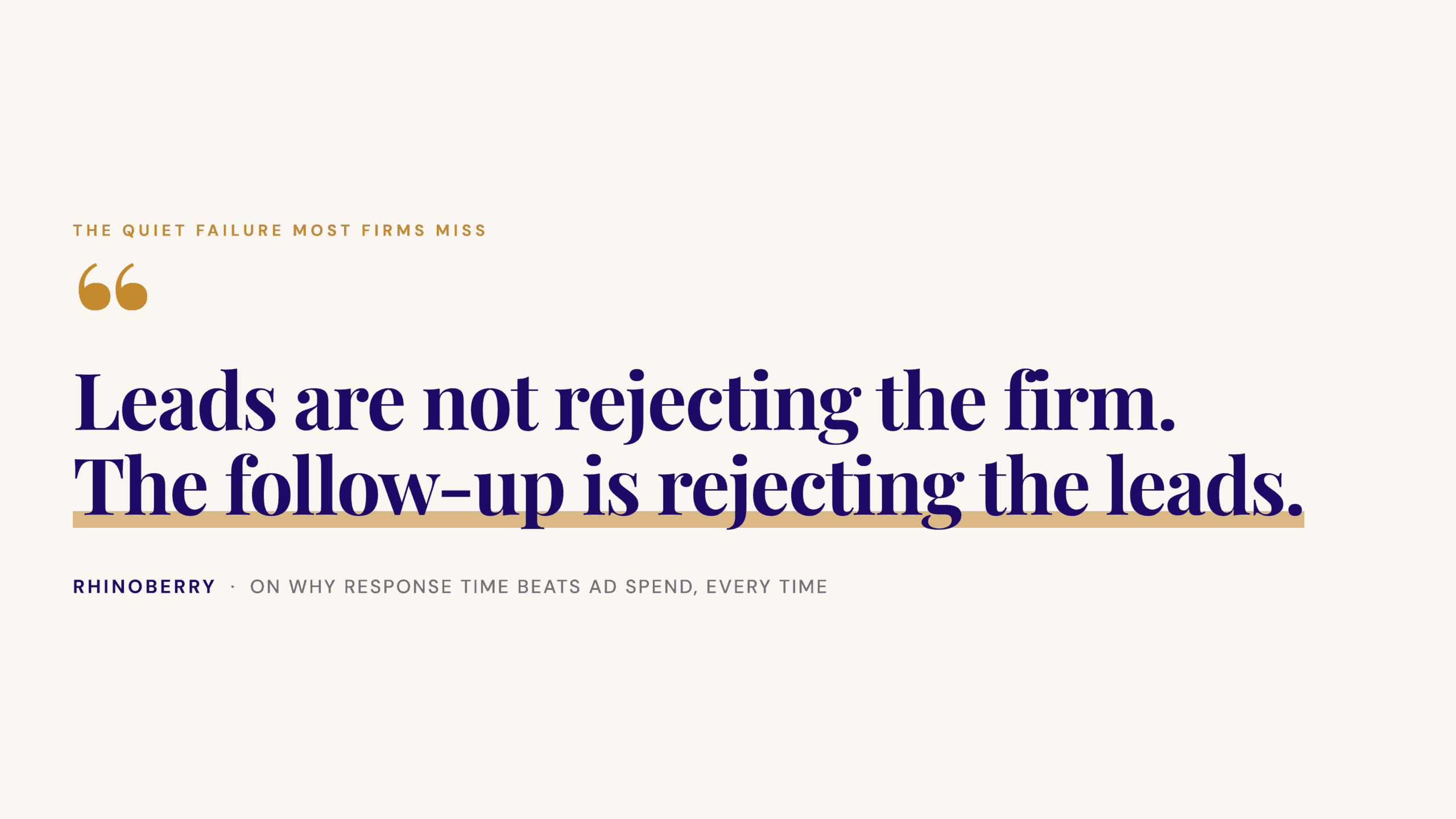
Leads are not rejecting the firm. The follow-up is rejecting the leads. Fix the follow-up and the same enquiry volume produces more clients.
First move — get an honest read on your response speed. Another one to hand to your assistant. Thirty minutes, one-page answer.
- Open the firm’s main inbox. Search the last six months for “enquiry”, “new client”, “quote”, and “pricing”.
- For each email that came in from someone who was not already a client, note the date received and the date of the first reply.
- Count two numbers: (a) leads that received a reply within 24 hours, (b) leads that took longer than 24 hours or got no reply at all.
- Work out the ratio. If (b) is more than 30% of the total, that is the ceiling the current system is putting on growth.
- If it’s above 50%, the problem is not the marketing. It is the follow-up.
Whatever the number is, do not shoot the messenger. This is almost always a system gap, not a people gap.
So What Now
Three systems. Invisibility, Capture, Follow-Up. Each one is a leaking layer. Any one of them left unfixed will cap the practice at whatever revenue point the original referral engine topped out at, which for most SA firms is somewhere in the R3M to R6M band.
None of the fixes require the partner to become a marketer. They do require the partner to recognise that the business has outgrown its original client-acquisition model. The model that worked for twelve years on trust and a strong network is not broken. It is just no longer enough on its own. Technical excellence is still required. It is no longer sufficient.
RhinoBerry’s wider work on the same territory sits under the accounting firm hub and the lead generation hub. Both cover the operating side of what this article names structurally.
If you’d like an outside set of eyes on which of these three systems is your biggest gap, we’re happy to take a look. A short conversation costs nothing, and even without engaging us you’ll leave with a clearer picture of where to start. Send us a note or reply to this article and we’ll set up a call.
If the referral network is still growing, ignore this article. If it is not, the three systems above are the operating gap. The cost of leaving them unfixed compounds every quarter they stay open. Conservative projections, not dramatic ones. Standing still in a competitive market means falling behind.
<Frequently Asked Questions
Why has my accounting practice stopped growing?
If the work quality has not changed and clients are not leaving, the cause is almost always structural rather than technical. Three systems are typically missing once the founder’s referral network stops carrying the whole pipeline: Google visibility, a qualifying asset on the website, and a follow-up sequence for new enquiries. Each of the three caps growth at a different point, and together they explain most R3M-to-R6M revenue plateaus in South African accounting firms.
How do I get my accounting firm to show up on Google in South Africa?
Start with the five-step checklist in Reason 1 above: search your target phrases (“accountant near me”, “accountant [your suburb]”), check whether your Google Business Profile is claimed and fully completed, count your reviews, and test your website on a mobile phone. If the Google Business Profile is incomplete or you have fewer than ten reviews, that is the first fix, before any spend on ads or SEO.
What should an accounting firm website do besides display contact details?
It should help a visitor diagnose their own problem and let them self-qualify before any fee conversation. The practical format is a short self-assessment (two to three minutes to complete) that produces a useful result for the visitor and a qualification signal for the firm. See the four-option shortlist under Reason 2’s First Move.
Why do leads go cold on my accounting firm?
In almost every case, the practice has no automated system to hold the lead between when they first enquire and when the firm has capacity to speak to them. Digital-sourced leads move on inside 48 hours. The fix is a short automated email sequence triggered the moment the lead completes the capture asset from Reason 2 — three to seven emails of genuinely useful context, ending with a clear next step.
Is this framework specific to accounting firms or does it apply to other professional services?
The three-system structure (Visibility, Capture, Follow-Up) applies to any professional-services firm that was built on referrals and hit a revenue ceiling. The specific inputs change by niche (the search keywords differ, the right self-assessment differs, the nurture sequence content differs) but the structure is the same. The examples and data in this article are calibrated for South African accounting, bookkeeping, and tax firms.
About the Data
This article cites live keyword data from RhinoBerry’s internal SpoorSny analysis (April 2026) alongside published external research from Jetpack Workflow, Accounting Today, Sage, Amanda C. Watts, and RenTech Digital. All external citations link to the original source. Search volumes and cost-per-click figures reflect South African market conditions at the time of writing and will change over time. For the latest figures, visit rhinoberry.com or request a current data snapshot.