Sixty percent of law firms never reply to a new client’s email. That statistic gets attention. It is also the wrong one for a referral-built practice to worry about first.
The follow-up failure costing referral-dependent firms the most is not the one on a stranger’s first message. It is the one on a client they already signed. Three systems cap most South African law practices between R3 million and R6 million. Here is what happens inside the third one: a file goes quiet for weeks. The client waits, checks their phone, and tells other people about the wait instead of the win.

This Article Is Not About the Leads You Never Answered
We have already covered why enquiries that never became clients go cold. A new enquiry lands on WhatsApp between two client meetings, and by the time anyone replies, the prospect has called someone else. That diagnosis stands.
This is a different failure, and a more expensive one for a referral-built firm specifically. It is what happens after a client has already signed, already paid a retainer, already trusted the firm with something that matters to them. Then they hear nothing for weeks while their case sits mid-process.
A missed lead costs one potential client. A silent existing client costs that client, plus every person that client would otherwise have referred.
Referrals are blamed on a shrinking network. Often the network did not shrink. It stopped hearing good things.
Why a Referral Engine Cannot Survive Going Quiet on the People Feeding It
A referral-built practice runs on one asset: people who already used the firm, telling other people to use it too. That asset is built entirely out of how a client feels during the case, not just how the case ends.
A client who wins but was ignored for six weeks in the middle does not become a referral source. They become someone who says, when asked, “the outcome was fine, but good luck getting them to answer you.”
Systems are blamed before people here too. The attorney working the file is not lazy. There is usually no system holding the file between hearings. No owner is assigned to a status update. No trigger fires when a matter has gone quiet past a set number of days.
The work absorbs the attention. The update does not happen because nothing forces it to.
What South African Clients Are Already Saying About This
None of the international content on this topic uses a single named, verifiable South African example. Real reviews on Hellopeter do.
“I have been requesting prescription letters from Lynn and Main Attorneys for a while no progress and no communication. Despite multiple follow-ups, I still have no updates or timelines. I was told call back or email.”
Anita K, Hellopeter review of Lynn & Main Attorneys, 5 March 2026
A second, shorter but no less telling:
“Nor GL Attorneys nor FNB are responding.”
George V, Hellopeter review of GL Attorneys, 22 July 2026
A third, on a deceased estate matter:
“Their employees don’t even give proper feedback. I’ve asked for financial assistance three months ago, until now I haven’t received it, and they don’t say anything until I ask. They will then respond.”
Nokugcina A, Hellopeter review of PGA Attorney, 1 July 2026
Even the highest-rated law firm on Hellopeter, 4.88 out of 5 across 132 reviews, still averages 32.31 hours to reply to a client. 18% of its replies take more than 36 hours. If the best-performing firm on the platform runs at that speed, the follow-up gap is not a bad-apple problem. It is the default state of the industry, and every firm that closes it stands out by doing something most competitors simply do not.
The International Benchmark Nobody Wants to Admit To
No South African study of this exact scale exists yet. The closest comparable data comes from a Clio-commissioned mystery-shop study that emailed 1,000 US law firms and phoned 500 more, testing how they handled a potential client’s first contact.
Sixty percent never responded to the email at all. Twenty-seven percent never answered or returned a phone call. Of the firms that did respond, 71% were rated unsatisfactory on how they handled it. Only 0.5%, roughly one in two hundred, were rated excellent.
That study measured first contact, not an existing client mid-case. The Hellopeter evidence above suggests the pattern does not improve once the client has already signed. Seventy-eight percent of prospects hire the first lawyer who responds to them, according to research cited by legal-CRM vendor Lawruler.
The data disagrees with the idea that legal work speaks for itself once the retainer is signed. It keeps speaking, in the client’s head, every day the file stays quiet.
What a Follow-Up System Actually Looks Like
A note in a diary is not a system. A system survives the attorney being in court, in a hearing, or simply buried for a week. Four components, in order of how quickly each is worth installing:
- A named owner per open matter. Not the attorney handling the substance of the case. Someone, even a candidate attorney or paralegal, responsible only for whether the client has heard something in the last agreed window.
- A fixed check-in interval, set at intake. Seven days for an active matter, longer for one genuinely waiting on an external process like RAF or Home Affairs. The client is told the interval up front, so silence within it does not read as neglect.
- A trigger, not a memory. A calendar reminder, a case-management flag, or a simple shared spreadsheet with a “last contact” column that someone actually checks. The Clio study above shows what happens when the trigger is a person’s memory alone.
- A template that takes two minutes, not a fresh email each time. “No major update this week, still waiting on [X], expected by [date]” is a complete, honest, two-minute message. It is not nothing. To a client who has heard nothing in three weeks, it is everything.
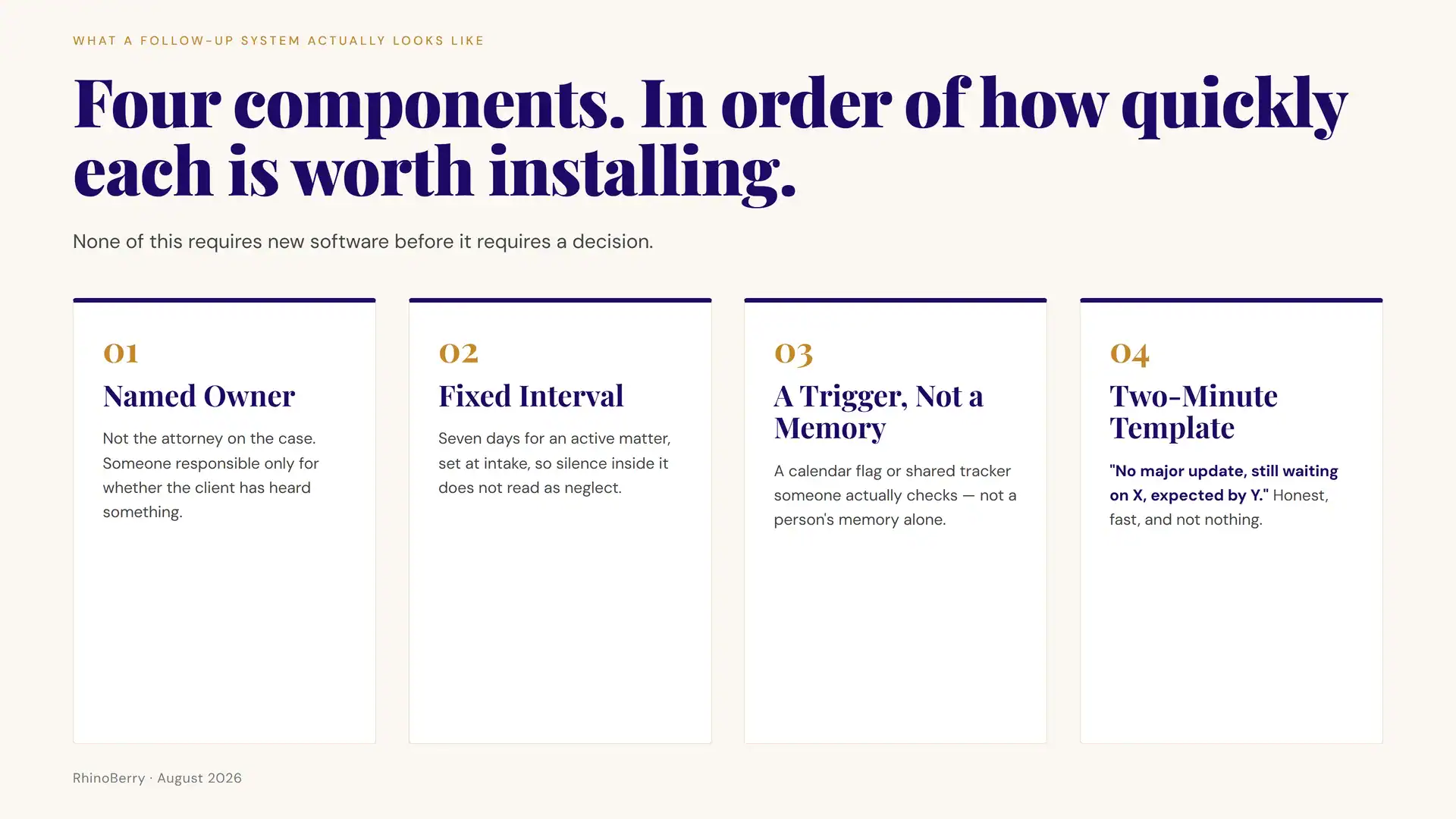
None of this requires new software before it requires a decision: someone owns the update, on a fixed clock, with a trigger that does not depend on memory.
So What Now
Three systems cap most referral-built South African law practices. This article covers one of them in its sharpest form. Not the lead the firm never answered. The client the firm already has, going quiet at the exact moment that client is deciding whether to ever refer anyone again.
Doing nothing here is not free. It is the slow, invisible version of losing the referral engine the whole practice depends on, one unanswered file at a time.
If your firm has never mapped how long a client waits, on average, for a status update mid-case, that is the first move. Not a new system. A number. Once the number exists, the fix is usually smaller than firms expect.
Our wider work on this and the other two systems sits under the law firm growth hub. A short conversation about which one is costing your practice the most costs nothing to have.

Frequently Asked Questions
Why do law firm clients complain about no communication even when their case is progressing normally?
Most firms have no system that separates “no update because nothing has changed” from “no update because nobody checked.” A client cannot tell the difference from the outside. A fixed check-in interval, communicated at intake, closes that gap without requiring the case to actually move faster.
Is a missed follow-up with an existing client worse than a missed new lead?
For a referral-dependent firm, usually yes. A missed lead costs one potential client. A client who was already won but left waiting in silence stops referring others. That caps the exact channel most small South African law firms depend on to replace the leads they never had a system for.
What is the fastest way to check if this is happening at my firm?
Search your own inbox and WhatsApp for the last three months for words like “update,” “any news,” or “checking in,” sent by an existing client. Note how long each one waited for a reply. If the average is longer than the interval you would want if you were the client, the gap is real and measurable today.